
When a human resource (HR) system works well, you barely notice any HR challenges. Onboarding is seamless, payroll runs on time, employees find answers without chasing HR, everything just flows.
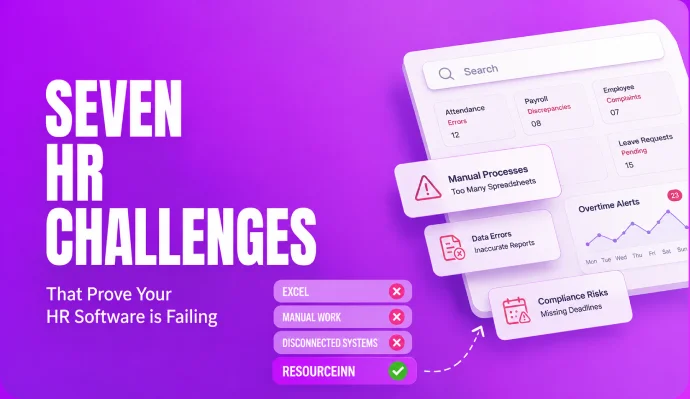
Unfortunately, its failure also doesn’t always announce itself with big breakdowns. More often than not, it creeps in quietly, disguised as everyday HR problems and frustrations. You think it’s your team’s fault, in reality, it could be the software or manual spreadsheets you are using.
That’s why it’s not wise to just look for surface-level errors and put blame on your HR department. For years, I’ve relied on a simple but effective model to spot whether an HR system is quietly failing:
On-The-Surface HR Challenges→ What They Signal → Quick HR Software Diagnostic Check → How to Fix
Now using this model, let’s walk through the subtle signs of a failing HR software. If these scenarios feel familiar, I’ve got some bad news waiting for you at the end of this section.
How to Spot Common HR Issues That Signal HR Software Failure
When a system starts failing, it shows up in small cracks that quietly compound into bigger problems. These issues drain productivity and erode trust across the organization, which means you are not only burning cash on a system that isn’t helping, you’re also risking your top talent walking out the door.
Here’s how you can spot those silent warning signs of your HR system not working before they become costly headaches:
The 90-Day Goodbye
Let’s start with hiring. Do you notice a pattern where new hires join, stay for two or three months, and then leave? Your managers might label it as a “bad cultural fit” or even a poor hiring choice. But when this keeps repeating, it usually means something deeper.
There is a possibility that those employees were never truly on-boarded. They didn’t get the right equipment on time, no structured training, and no buddy or manager check-ins to anchor them in.
This means that your workflows for on-boarding aren’t being tracked, automated, or enforced. The system isn’t ensuring those critical early steps happen, so new hires slip through the cracks before they’ve even had the chance to perform.
Month-End Crisis Week
Take a closer look at payroll week. Does your HR team come out of it looking like they’ve just fought a war? On the surface, it shows up as off-cycle corrections, last-minute adjustments, and endless “manual fixes”.
This reflects how your payroll process isn’t running on policy, it’s running on exceptions. The calculations don’t reflect actual overtime, allowances, or deductions, so your team spends hours patching gaps.
That’s one of many HR software challenges; your payroll engine isn’t enforcing the rules you’ve set. Instead of working as the backbone of accuracy, it forces your people into firefighting mode every single month.
The Policy Telephone Game
Ever notice how different teams seem to “remember” policies in completely different ways? One department swears employees can carry over leave days, while another insists they can’t. Expenses that get approved in one team are rejected in another. Apparently, it looks like simple miscommunication.
In reality, it shows that your policies are stuck in static PDFs or buried emails, not embedded in the HR system itself. With no single source of truth, everyone interprets the rules differently.
This translates to your platform not enforcing policies consistently. Instead of clarity, you get endless clarification meetings and company-wide emails about years-old policies that should have been automated in the first place.
Schrödinger’s Headcount
Ask Finance, HR, and IT how many employees are on the books, and you’ll get three different answers. It looks like a reporting mix-up but when the headcount can’t be pinned down, it usually means deeper HR challenges.
One team might see a resource as active, another marks them terminated, and payroll could still be issuing checks.These gaps can hide ghost employees, enable HR fraud, or reflect broken system integrations. Even in a 1,000-employee company, hiring 5–10 people without proper workforce planning can quietly drain profits.
Without a single source of truth, you’re never fully sure who’s actually on your payroll.
The Flatline Performance Curve
Take a look at your performance reviews. Does it feel like everyone ends up with the same rating year after year, “Meets Expectations”? It looks safe, even fair but when nobody stands out and nobody falls behind, the system isn’t really measuring performance at all.
Your company goals aren’t being set properly, feedback cycles aren’t happening on time, and calibration between managers is missing. Your failing HR system is turning your precious performance data into little more than paperwork. It stops driving growth and starts collecting dust, adding to HR challenges.
Outdated Permissions
Someone leaves, switches roles, or just needs temporary access once and months later, they still have it. It may look like a small oversight but it conveniently proves that your system’s role permissions are too rigid to manage properly.
HR or IT ends up granting broad access just to “get things done,” and then never fully closes the loop. In today’s world of constant breaches, one lingering login can be the crack that opens into a full-scale cyber attack
Rather than safeguarding company data under ISO and GDPR standards, the platform quietly creates permanent security and compliance vulnerabilities.
The DM-First Culture
You’ve invested thousands in an HR system to address common HR challenges, yet your inbox and email are flooded with the same questions: “What’s my leave balance?” “When’s payroll?” “How do I file expenses?” Most HRs dismiss this saying that employees just aren’t paying attention.
What’s actually happening is that your HRMS has poor user interface, difficult navigation, and weak search functionality. Employees default to DM’ing HR because they can’t quickly find the answers they need on the platform.
Remember: when a tool creates more confusion than clarity, people bypass it altogether and that stamps failure on the software.
Why HR Issues Happen And How Your HRMS Contributes
Even after investing significant time, money, and energy into your solution, the software can still fall short. It’s perfectly natural to ask why. The truth is, there are several reasons an HR system might fail, and understanding these can help you take the right steps to fix it.
Here’s why your HR software might be holding you back:
- Your business has unique workflows and complex policies. The system wasn’t built to handle them, which creates bottlenecks and extra work
- You’ve outgrown your system. As your team grows and your needs evolve, the software that once worked perfectly may no longer keep up
- The solution doesn’t match your feature needs. Sometimes the solution you picked just isn’t designed for your specific HR challenges or the way you work
- Implementation didn’t go smoothly. Even the best software can under perform if it wasn’t set up properly for your processes
- The software is slow or hard to use. If your employees and HR team struggle to navigate it, adoption drops and productivity suffers
- Customer support isn’t available when you need it. No matter how good the product is, lack of support when needed can prevent your system from performing at its best
- Your HR system puts company’s most sensitive data at risk. Without ISO certification, regular audits, and proper access controls, it becomes vulnerable to breaches, fraud, and costly violations
HR Challenges And How Smart Businesses Fix Failing HR Systems
If you are still reading, chances are these signs and reasons resonated with you, meaning the HR software you are using is failing. That’s bad news but don’t panic; there’s a way forward. The key is to approach the problem methodically. Here’s how you can fix it:
Understand Your HR Challenges
The first step is to figure out why your HR system isn’t performing as expected. Is it due to poor implementation, missing features, scalability issues, or simply a mismatch with your workflows? Identifying the exact cause will guide your next steps.
Talk to Your Vendor
If the HR problem lies in setup or functionality, reach out to your vendor. Many issues can be resolved through proper configuration, additional training, or feature adjustments. This can save time and cost without needing a full system change.
Consider Smarter HR Solutions
If your current platform still falls short despite attempts to fix it, it’s time to replace your HR software. Platforms like Resourceinn are designed to streamline payroll, attendance, approvals, and reporting, all in one place.
Take Action Immediately
The thought of switching your HR software system because of your HR challenges might be daunting but it’s worth it in the long run.The best way forward is to connect with an experienced HR software consultant from Resourceinn who can guide you through your options.
ABOUT RESOURCEINN:
With over a decade in the market and partnerships with leading names in HR, Resourceinn delivers configurable HCM solutions trusted by businesses worldwide. Our vision is to be the #1 HR solution globally by equipping companies with solutions that truly solve their human resources management challenges.
Let’s build an HR ecosystem that actually works for your people.