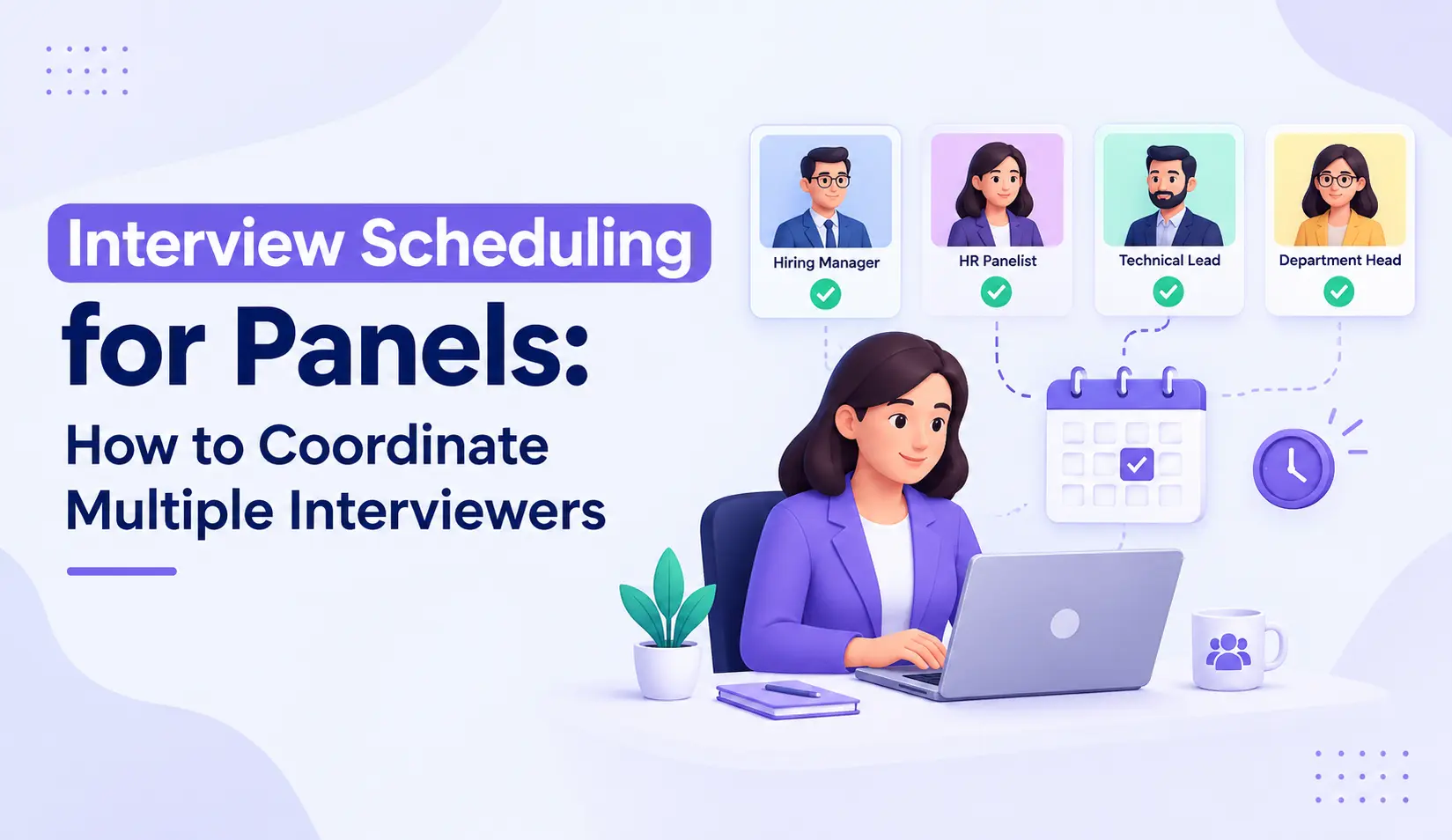

You have a strong candidate, five interviewers and one hour that has to work for all of them. Three days later, the email thread is still growing and nobody has confirmed a time. This is interview scheduling at its worst, and it gets harder with every extra person on the panel.
This guide shows you how to coordinate multiple interviewers without the email chains. You will get a clear definition, five steps you can use this week, the mistakes that cause delays, and what to look for in a recruitment system.
What Is Interview Scheduling for Panels?
Interview scheduling is the work of finding a time that suits the candidate and every person who needs to interview them, then confirming it and keeping it stable. Interview scheduling for panels adds a harder layer. A panel interview puts one candidate in front of several interviewers at the same time. Many teams also run a loop, where the candidate meets interviewers one after another. Both formats need the same coordination.
That is why panel interview scheduling is less about booking a slot and more about interview coordination. Someone has to decide who attends, how long each session runs, who the backup is and how the candidate hears about it. Done well, it keeps your talent acquisition process moving instead of stalling at the calendar.
Why Panel Interview Scheduling Breaks Down
When you schedule interviews with multiple interviewers, every added calendar multiplies the ways a plan can fail. These are the problems you will see most often:
- Calendars rarely overlap. Interviewers have meetings, travel and focus time, so the shared free time is small.
- Email threads keep restarting. Each reply changes someone’s availability, so the search begins again.
- Nobody owns the schedule. When three people can move a booking, no one is accountable for it.
- Time zones cause confusion. Remote panels and remote candidates make a wrong time easy to send.
- Late cancellations break the panel. One missing interviewer can mean a full rebook.
One practitioner asked for help booking four separate candidates with a panel of four interviewers, using long sessions with a gap between each. A single change moved every session after it.
Delay has a cost. SHRM’s 2026 recruiting benchmarking puts the median time to fill a nonexecutive position at 39 calendar days, and that clock keeps running while you wait for calendars to line up. Candidates who wait may accept other offers, which can drain your talent pipeline.
How to Schedule Interviews With Multiple Interviewers, Step by Step
Follow these five steps in order.
Step 1: Lock the interview plan before you book anything
Decide who must attend, who is optional, how long each session runs and what each interviewer will cover. If you use structured interviews, agree the questions and scoring now. The U.S. Office of Personnel Management encourages agencies to consider structured interviews, and its guidance on structured interviews describes them as among the most valid assessment tools available. A fixed plan also tells you how much time you need to find.
Step 2: Set fixed availability windows for every interviewer
Ask each interviewer for two or three recurring blocks, such as Tuesday and Thursday afternoons, and hold those blocks for interviews. Good interview coordination starts here, because you search inside agreed windows instead of chasing open calendars. Name one person who owns the schedule and can move a booking.
Step 3: Choose between one panel and rotating one-on-ones
A single panel session saves the candidate time but needs every interviewer free at once. A loop of one-on-ones is easier to place but takes longer overall. For panel interview scheduling, pick the format before you look for slots. Limit the panel to the people who will score the candidate.
Step 4: Offer candidates a small set of slots, or one booking link
Find the overlap in your availability windows, then offer the candidate two or three options, or one booking link that shows only open times. If you want to know how to schedule interviews without a long exchange, this step does most of the work. The candidate chooses once and everyone is booked. Put the time zone in every message.
Step 5: Confirm, remind and agree a backup rule
Send one calendar invite with the video link or room, the agenda and a contact person. Send a reminder the day before. Agree a backup interviewer in advance, and set a cutoff for changes, such as 24 hours before the interview, after which the schedule is locked.
Interview Scheduling Best Practices for Panels
These habits keep a panel schedule stable once it is booked:
- Leave a gap between sessions. Scheduling guides commonly suggest 5 to 15 minutes so interviewers can write notes and reset.
- Limit back-to-back interviews. Fewer consecutive sessions give each interviewer time to prepare.
- Use consistent windows. Repeating blocks give candidates and interviewers a predictable pattern.
- Send the agenda early. Candidates know who they will meet and what to prepare.
- Plan for time zones. Write the time zone beside every time, and avoid giving the same person the earliest or latest slot every time.
Use this list as a checklist, and you should rebook less and spend more time evaluating candidates.
Common Scheduling Mistakes to Avoid
Many of the common recruiting mistakes that slow hiring show up at the calendar. Watch for these:
- Putting the same three people on every panel because their calendars are easiest to find.
- Inviting too many interviewers, which makes every booking harder.
- Leaving no owner, so nobody can confirm or move a time.
- Skipping a backup, so one cancellation cancels the interview.
- Rescheduling through an email thread instead of one shared calendar.
How an HRMS Can Help Coordinate Interviewers
A spreadsheet and a shared inbox can work for one panel. They stop working when you run several roles at once. A recruitment management system gives your team one place for candidate records, interviewer calendars and interview stages.
When you compare systems, check whether they sync with your calendars, show shared interviewer availability, send invites and reminders, and let you reschedule from one screen. Better interview coordination also gives you a record of who interviewed whom, and when.
Frequently Asked Questions
How do you schedule an interview with multiple interviewers?
Start by fixing the interview plan: who must attend, how long each session runs, and which interviewers are optional. Next, ask each interviewer for set availability windows, find the overlap, and offer the candidate two or three slots from it. Send one calendar invite with the video link or room, and name a backup interviewer in case someone drops out.
How do I create an interview schedule?
List each interview stage, the interviewers for that stage, and how long it runs. Add a short gap between sessions so interviewers can write notes, and include the time zone, the location or video link, and a contact person for the candidate. Share the schedule with the interviewers and the candidate before the day.
How much time should you leave between interviews?
Scheduling guides commonly suggest a gap of about 5 to 15 minutes between sessions. The gap gives interviewers time to write notes and reset before the next conversation. For back-to-back panel rounds, use the longer end of that range.
What should you do when an interviewer cancels?
Agree on a backup interviewer before the interview is booked. If someone cancels, offer the candidate the same slot with the backup if the role allows it, or move the session as early as possible and tell the candidate right away. Allow changes until a set cutoff, such as 24 hours before, and lock the schedule after that.
How can an HRMS or ATS help with interview scheduling?
A recruitment system can keep candidate records, interviewer calendars and interview stages in one place. Depending on the tool, it can sync calendars, show shared availability, send invites and reminders, and collect feedback after each interview. Check which of these features your system supports before you rely on it. Panel scheduling feels hard because the problem is coordination, not calendars. Fix the plan, set windows, pick a format, offer a few slots and agree a backup. That is how to schedule interviews with several people without losing a week. Apply the interview scheduling best practices above, and if you want your whole hiring workflow in one place, look at all-in-one HR software built for HR teams.