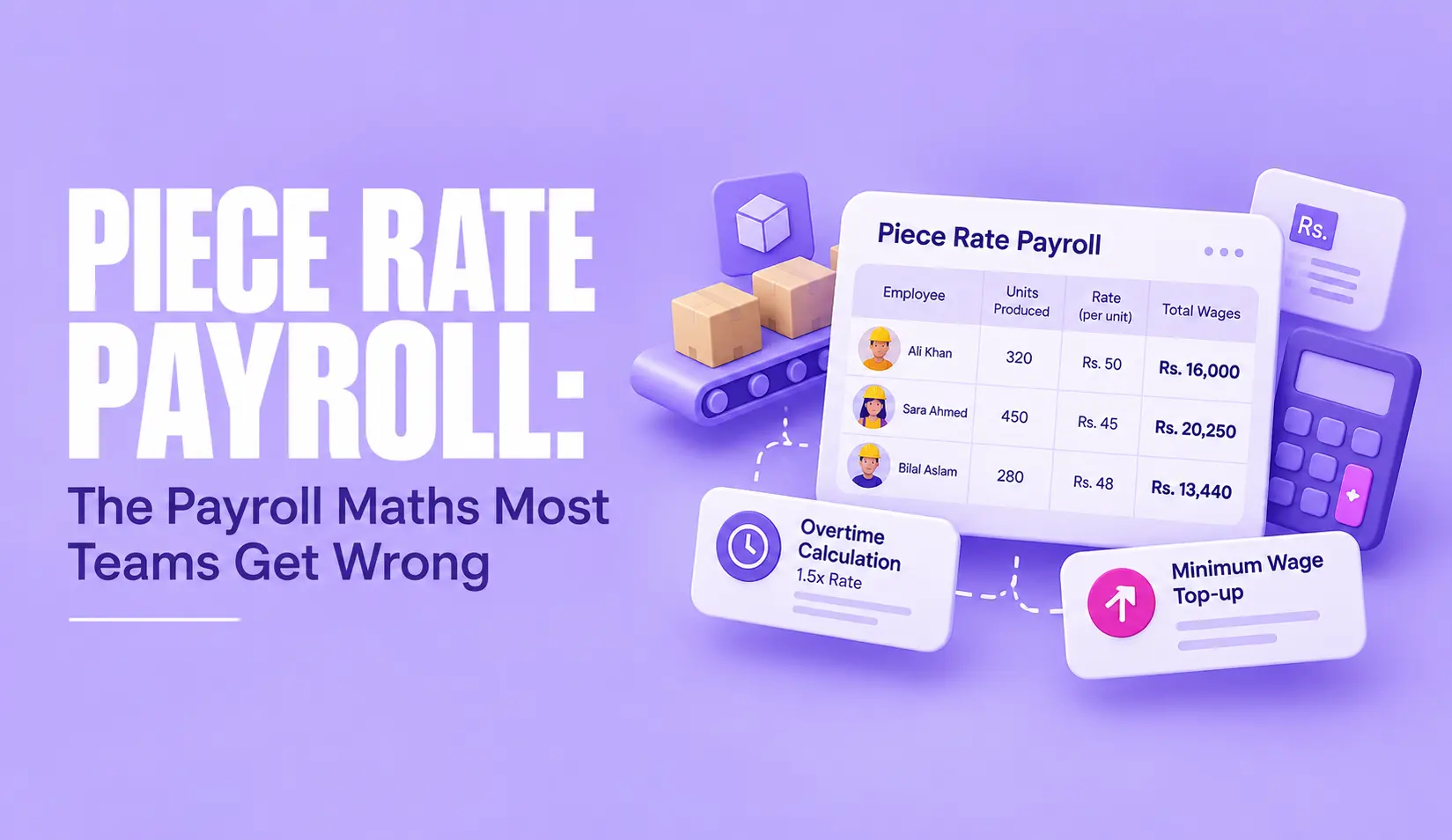

Picture a packing team paid by the box. The pay slips look fine for weeks. Then one worker puts in 50 hours, and nobody is sure how to add overtime to pay that was never tied to hours. Piece rate payroll looks simple until hours, minimum pay and overtime enter the sum. This guide walks through the maths with real numbers, so you can check your own pay runs against it. You will also see three mistakes to look for before the next pay run.
What Is Piece Rate Pay?
So what is piece rate pay in plain terms? It is a way of paying an employee for each unit they complete, not for each hour they work. A unit can be a garment sewn, a box packed or a stop delivered. The earnings are a form of incentive pay, because more output means more money. You may also hear it called piece rate compensation or piecework pay.
Here is the short version:
- Pay basis: units completed, not hours worked.
- Basic formula: units × rate per unit = piece rate pay.
- Still needed: a record of hours, because minimum wage and overtime checks depend on them.
Piece rate payroll is built on that formula, then checked against hours.
Piece Rate Pay Examples by Industry
These piece rate pay examples show the same formula in different settings:
- A farm worker paid $2.50 per crate fills 40 crates and earns $100.
- A repair technician paid $12 per completed ticket closes 9 tickets and earns $108.
The formula never changes. Only the unit does.
How Piece Rate Payroll Works
Piece rate payroll follows five steps in every pay period:
- Count the output. Record the units each person completed.
- Apply the rate. Multiply units by the rate per unit. Different tasks can carry different rates.
- Record the hours. Use online attendance management or a timesheet to log every hour worked, including time spent waiting or on tasks that earn no pieces.
- Check the floor. Divide total pay by total hours and compare the result with any minimum wage that applies.
- Work out overtime. If overtime rules apply, calculate the extra pay from the regular rate for the week.
Steps 3 to 5 are where the maths gets harder, because they need hours and not just output. In piece rate payroll, a missing hour in step 3 changes the answers in steps 4 and 5. For the full pay cycle around these steps, read our guide to the payroll process.
Piece Rate Wages: The Basic Calculation
Piece rate wages start with one line of arithmetic: units completed × rate per unit. A worker who completes 120 units at $1.50 each earns $180.
That is only the gross piece earnings. It says nothing about the time behind it. If the worker needed 20 hours, the hourly equivalent is $9.00. If the same work took 30 hours, it is $6.00.
The Overtime Maths Teams Get Wrong
Overtime is the trickiest part of piece rate payroll, because the piece earnings already pay for every hour worked, including the overtime hours.
The method is set out in the US federal regulation on pieceworkers. Add all piece rate wages and other pay for the week. Divide by all hours worked to get the regular rate. For each hour over 40, pay an extra half of that regular rate.
Here is a worked example. A worker puts in 50 hours. They earn $491 in piece rates for 46 productive hours. They also earn $8 an hour for 4 hours of waiting time, which is $32.
- Total pay for the week: $491 + $32 = $523.
- Regular rate: $523 ÷ 50 hours = $10.46 an hour.
- Overtime premium: half the regular rate × 10 overtime hours = $5.23 × 10 = $52.30.
- Total pay: $523 + $52.30 = $575.30.
The $491 and $8 figures come from the regulation’s own example. The premium is worked out from them.
Why only half? The piece earnings already pay straight time for all 50 hours, so only the extra half is owed on the overtime hours. This is explained in the Texas Workforce Commission’s guidance on the regular rate for pieceworkers.
None of this works without clean hours. Learn how to track overtime hours before you trust the totals.
Check your pay runs for these three errors.
Paying 1.5 Times the Rate on Top of Piece Earnings
Pay 1.5 × $10.46 × 10 hours on top of the $523 and you add $156.90 instead of $52.30. That overpays by $104.60, because straight time was already in the piece earnings.
Dividing by Productive Hours Only
Divide $523 by the 46 productive hours and the regular rate rises to about $11.37. Every overtime hour is then priced off the wrong rate. The regulation divides by all hours worked.
Leaving Out Other Pay
Waiting time pay and production bonuses belong in the weekly total. Leave them out and both the regular rate and the overtime premium come out too low.
Minimum Wage Top-Ups and Break Pay
Piece rate wages should never leave anyone below the minimum wage for the hours they worked, where a minimum wage applies. To check, divide the week’s earnings by the hours worked. If the result is below the minimum, the employer pays the difference.
Say a worker earns $140 in piece earnings over 20 hours. The hourly equivalent is $7.00. If the minimum is $7.25, the top-up is $0.25 × 20 hours = $5.00.
Break pay varies by place. Some jurisdictions require rest breaks to be paid separately from piece earnings, as California’s rule for piece rate workers, explained by CalChamber shows. Check local law before you set up any piece rate system.
Is a Piece Rate System Worth It?
A piece rate system has clear benefits and clear costs.
Benefits
- Labor cost per unit is predictable.
- Pay follows output, so effort is rewarded.
Costs
- Income varies from week to week.
- Speed can push quality down.
- Piecework pay still needs hours on file, so timekeeping does not go away.
- Rules differ by country and state.
How to Run Piece Rate Payroll Without Spreadsheet Errors
Piece rate payroll gets harder when one worker has several rates, a mix of hourly and piece pay, and overtime in the same week. A spreadsheet can hold the numbers, but it will not stop a wrong formula. A payroll management system that stores each rate and the hours behind it gives you one place to check the maths.
Before the next piece rate payroll run, confirm that:
- every unit count has a matching hours record;
- rates are stored per task and not typed in again each week;
- the regular rate is worked out from all pay and all hours;
- someone reviews any week with overtime or a minimum wage top-up.
Get the hours and the regular rate right, and piece rate payroll stops being a guessing game.
Frequently Asked Questions
What does piece rate pay mean?
Piece rate pay means an employee is paid a fixed amount for each unit they complete, instead of a fixed amount for each hour they work. A unit can be a garment sewn, a box packed or a delivery made. In many countries, minimum wage and overtime rules still apply to piece rate workers.
Can you give examples of piece rate pay?
A sewing operator paid $0.80 per finished garment who completes 200 garments earns $160 for the day. A packer paid $0.25 per box who packs 600 boxes earns $150. A driver paid a set amount per stop is also on a piece rate. In each case, pay equals units completed multiplied by the rate per unit.
How do you calculate piece rate pay?
Multiply the units completed by the rate per unit. Then divide total pay by all hours worked to find the hourly equivalent and compare it with any minimum wage that applies. If it falls short, the employer pays the difference. Where overtime rules apply, calculate overtime from the regular rate for the week before you finalize piece rate payroll.
Do piece rate workers get overtime?
In many countries they do. Under United States federal rules, you add total weekly earnings from piece rates and other pay, divide by all hours worked to get the regular rate, then pay an extra half of that rate for each hour over 40. Rules differ by country and state, so check local law before running piece rate payroll.
Is piece rate pay better than hourly pay?
It depends on the work. Piece rate pay rewards output and gives the employer a predictable labor cost per unit. It can also make income uneven for workers and push speed ahead of quality. Hourly pay suits work where output is hard to count or where quality matters most.
Which industries use piece rate pay?
Piece rate pay is common in garment and footwear manufacturing, assembly lines, farm harvesting, packing and route-based delivery. It suits work where each unit is easy to count and the task repeats.