
A manager tells you an employee has missed targets for three months. Now you need a plan on paper, and it has to be fair. This guide gives you a performance improvement plan template you can copy, a six-step process to run it, and sample PIPs for sales, attendance and quality problems. If you have wondered how to write a performance improvement plan that helps the employee and protects the company, start here. For performance improvement plan examples, skip to the examples section.
What Is a Performance Improvement Plan?
A performance improvement plan (PIP) is a written plan that gives an employee a fixed period to bring their work up to a stated standard. It names the gaps, sets measurable goals, lists the support the company will provide, and says what happens next. Some companies call it a performance action plan.
A PIP is a formal step, not a casual chat. OPM’s performance improvement plan quick guide describes it as a formal process in US federal agencies for performance below the fully successful level. It sits between informal coaching and a final decision, and it differs from a write-up, which records a single incident.
When to Use a PIP (and When Not To)
Use a PIP when the problem is a pattern, not a one-off. The employee has heard the standard, has had feedback, and performance is still below it. Skip it for a single incident, a policy breach, or a problem the company caused.
The biggest risk is using a PIP only to build a paper trail for dismissal. Many of these cases trace back to common talent management mistakes, such as vague goals and late feedback.
Before you put someone on a performance improvement plan, check three things:
- Did the employee know the standard?
- Did they get clear feedback before this point?
- Can the problem be fixed in the time you can offer?
If all three answers are yes, fill in your performance improvement plan template with facts, not opinions.
How Does a Performance Improvement Plan Work?
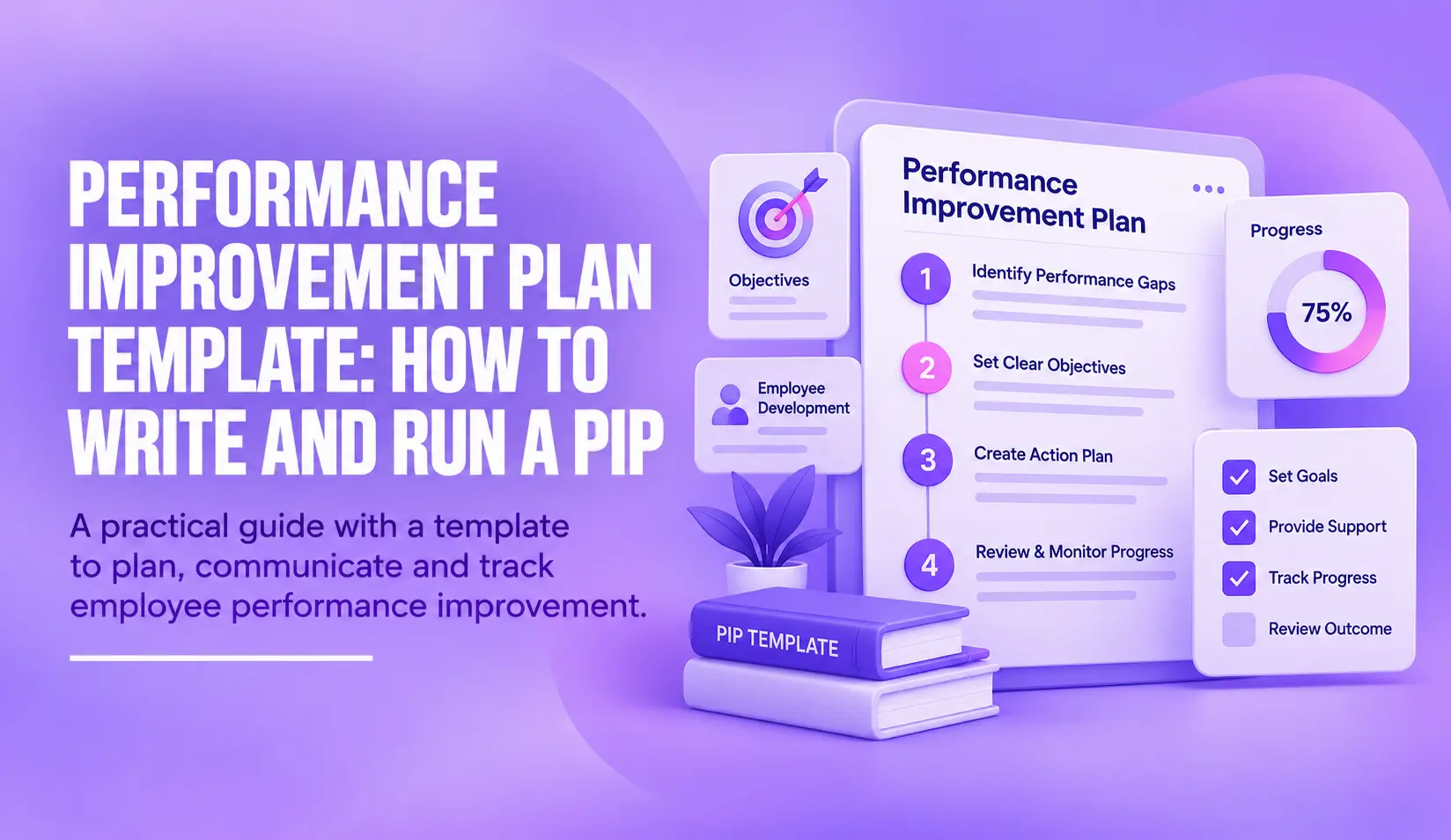
So how does a performance improvement plan work from start to finish? It runs in six steps.
Step 1: Document the gaps
List specific incidents with dates. Write “missed the weekly report deadline in four of the last five weeks,” not “unreliable.” SHRM’s eight elements of an effective PIP start with identifying specific incidents where performance fell short. For behavior problems, tie each gap to the behavioral competencies in the job description. Record it all on your performance improvement plan template.
Step 2: Set SMART goals
Turn each gap into a goal that is specific, measurable, achievable, relevant and time-bound. “Improve communication” is not a goal. “Reply to customer emails within 24 hours” is. Tie goals to the role’s KPIs so the employee can check progress alone.
Step 3: Add support
A PIP without support is only a warning. List what the company will provide: training, a mentor, a clearer workflow, or a lighter load while the employee learns. If you use training and development software, log the courses there.
Step 4: Set the timeline and check-ins
Most PIPs run 30, 60 or 90 days. A 30 day performance improvement plan suits a narrow problem such as a missed sales target. Use a longer period when the employee must learn a new skill. Put the end date and check-in dates in the plan on day one.
Step 5: Define the outcomes
Say what happens if the employee meets, partly meets or misses the goals. If the plan could end in dismissal, say so in plain words.
Step 6: Meet, sign and record
Walk the employee through the plan and let them comment. The manager and employee both sign and date it. Record every check-in, and save the completed performance improvement plan template Word file in the employee’s record. OPM’s performance management playbook tells agencies to document all steps and communications carefully.
Performance Improvement Plan Template
Ready to Improve Employee Performance? Download our free Performance Improvement Plan (PIP) Template to set clear goals, track progress, and guide employees toward success.
Keep the performance improvement plan template to two pages, because long plans bury the goals. If your team asks for a PIP form or format, use the same fields.
Performance Improvement Plan Examples
These performance improvement plan examples are illustrations. Each follows the performance improvement plan template above.
- Sales target. Gap: closed fewer deals than the agreed quota in each of the last three months. Goal: hit the quota in month one and hold it. Support: weekly call coaching and a shadowing day with a top seller. Period: 30 days.
- Attendance. Gap: arrived late on most days last month. Goal: arrive on time every working day, or tell the manager before the shift. Support: a review of the shift schedule. Check attendance records first, because patterns of absenteeism often point to a cause, such as a schedule clash. Period: 60 days.
- Quality of work. Gap: error rate above the team standard in weekly reports. Goal: meet the standard in 60 days, with a second person checking reports at first. Support: a checklist and one training session. Period: 90 days.
Use these performance improvement plan examples as a starting point, then replace every line with facts from your own records.
How to Write a Performance Improvement Plan: Tips for HR
Habits that make the plan hold up:
- Stick to facts. Use dates, tasks and results, not personality.
- Get a second review. Every performance improvement plan HR reviews should be checked for tone, facts and fairness.
- Treat people the same. Use the same performance improvement plan template and steps for everyone in the same situation.
- Plan for leave. If the employee takes approved leave, move the plan dates so they still get the full period.
That is the core of how to write a performance improvement plan that stands up to review. Handled this way, a performance improvement plan HR can stand behind gives the employee a real chance and gives the company a clean record.
Track Every PIP in One HR System
A performance improvement plan HR manages by email and spreadsheets is easy to lose track of. Use performance management software, or at least one shared tracker, to keep the goals, check-in dates and outcome in one record per employee.
Whatever tool you use, finish the performance improvement plan template, put the check-ins in the calendar and give the employee the support you promised.
Frequently Asked Questions
What should be in a performance improvement plan?
A performance improvement plan should name the employee, role, manager and HR contact. It should describe the performance gaps with dates and examples, state the standard expected, and set measurable goals. It also lists the support the company will give, the timeline with check-in dates, and what happens if the goals are met or missed. The employee and manager sign and date it.
How long should a performance improvement plan last?
Most PIPs run for 30, 60 or 90 days. Pick the length based on how long a real change takes to show. A missed sales target may show progress in 30 days, while a skill gap that needs training may need 90. Write the end date and every check-in date into the plan on day one.
What is the difference between a PIP and a write-up?
A write-up records one incident or policy breach, such as lateness or a missed deadline. A PIP covers a pattern of underperformance over time. It sets goals, support and a deadline. A write-up says what went wrong. A PIP says what must change, by when, and how the company will help.
Is a PIP a trap?
A PIP should not be a trap. Done well, it gives the employee clear targets, support and time to improve. It loses that purpose when a manager uses it only to build a paper trail for dismissal. Employees often read a PIP as a warning, so HR should be honest about the stakes and keep the goals fair and reachable.
What happens at the end of a performance improvement plan?
There are three common outcomes. The employee meets the goals and returns to normal performance reviews. The employee improves but not enough, so HR extends the plan or considers a better-fit role. Or performance stays below the standard and the company takes further action under its policy and local employment law. HR should record the result and share it in writing.
Can an employee take leave during a PIP?
Yes, employees can have approved leave during a PIP. HR should pause or extend the plan dates so the employee still gets the full period to improve. Rules on protected leave differ by country and state, so check with employment counsel before acting on a PIP when the employee is on leave.