
Your managers used to be your most engaged people. According to Gallup, that is no longer true.
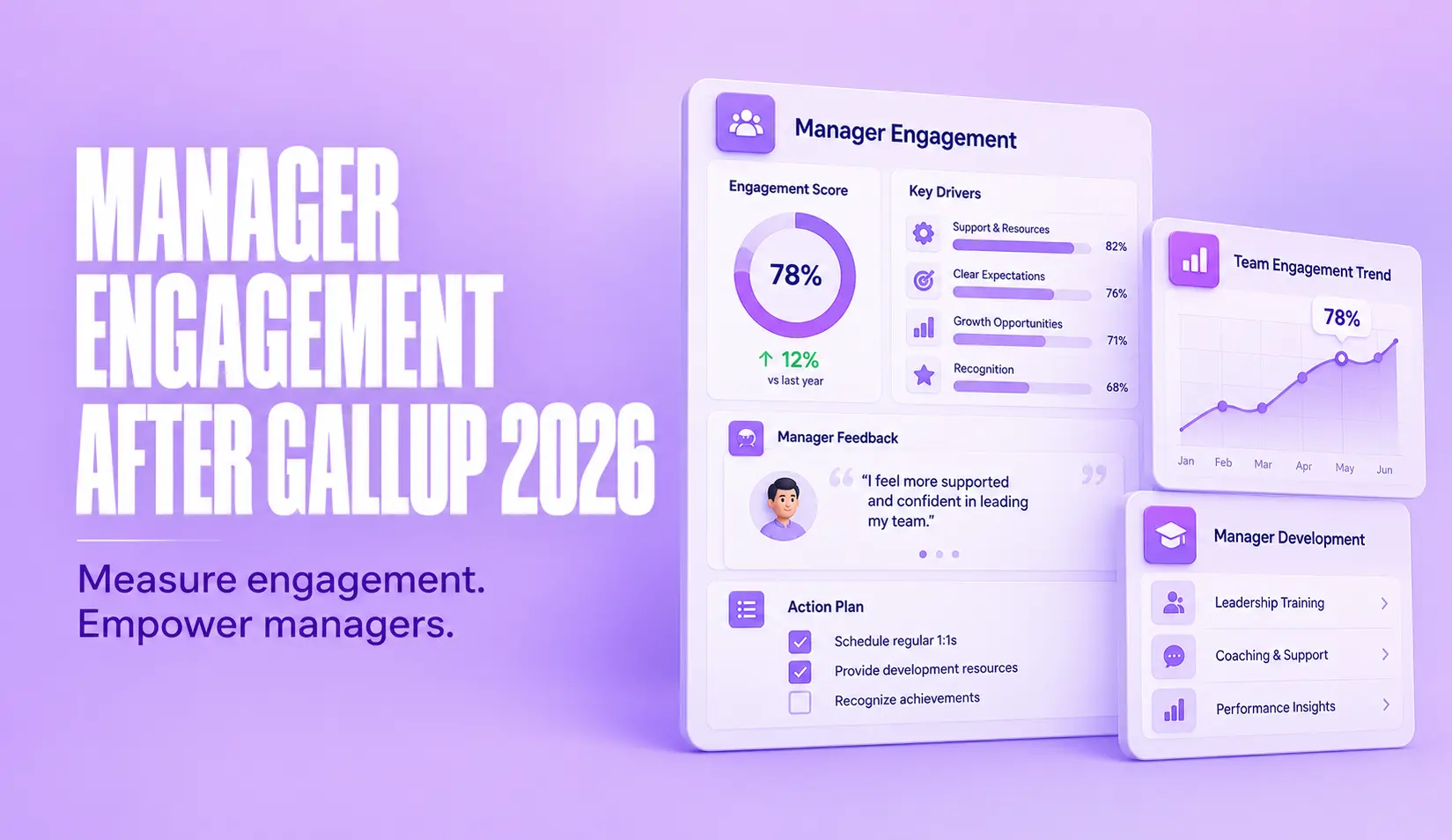
Gallup’s 2026 State of the Global Workplace report found that manager engagement fell from 27% to 22% between 2024 and 2025. Managers are now only about as engaged as the people they lead. If you work in HR, that changes your priorities, and it makes it urgent to know how to measure manager engagement with the same care you give everyone else.
Most companies already run employee surveys and engagement programs for their teams. Few ask managers how the job is going for them. This guide shows you how to fix that, what warning signs to watch for, and how to support managers once you have their answers.
What Is Manager Engagement and Why Did Gallup 2026 Change the Conversation
Manager engagement is the psychological attachment managers feel to their work, their team, and their employer. Gallup uses the same definition for every worker. It is different from employees rating their manager. One asks whether managers feel supported and motivated. The other asks whether employees feel supported by them. Both belong in your employee experience plan, but they need different questions.
The timing matters. Gallup put global employee engagement at 20% in 2025, the lowest level since 2020 and the first time it has fallen two years in a row. Gallup also estimates that managers account for about 70% of the variance in team engagement. When engagement slips at the manager level, it reaches everyone beneath them.
Managers are also stretched. In HR Executive’s report on a July 2024 Gartner survey of 805 HR leaders, 75% said managers are overwhelmed by expanding responsibilities and 69% said managers are not equipped to lead change. The missing support has a name, manager enablement. Gallup’s Manager Enablement Index uses five benchmarked questions about what frontline managers need to do their jobs well.
How to Measure Manager Engagement
Here is how to measure manager engagement without a heavy new program. You need a short, separate survey and a clear plan for the results.
Ask Managers About Their Own Role
Run a manager engagement survey alongside the company survey. Managers should still answer the company survey as employees. The extra survey asks about the conditions of the manager job. Five areas cover most of what you need.
- Clarity of expectations. Do managers know what good looks like?
- Tools and resources. Do they have what they need to run the team?
- Training and coaching. Has anyone taught them how to manage?
- Workload. Can they do the people part of the job, or only their own tasks?
- Support from senior leaders. Do they get time and help when things get hard?
These five areas are a practical starting point, not a fixed standard. Adapt them to your company.
Keep the Manager Survey Short
Aim for five to seven questions and about two minutes. Use one rating question for each area, plus one open question such as “What one change would make your job easier?” Keep the wording the same every cycle so you can compare results over time. Twice a year is a sensible rhythm to start with.
Protect Anonymity in a Small Group
Manager groups are small. In a department with eight managers, it is easy to guess who wrote what. Report results by group only when enough managers have answered, and roll small groups up to the next level. A minimum of five responses is a common floor. Pick yours and tell managers what it is before they answer.
Signs of Disengaged Managers
Survey scores are one signal. Day to day behavior is another. Disengaged managers often show a few patterns.
- They skip or shorten team meetings.
- They hold fewer one to ones.
- Approvals and reviews pile up past their deadlines.
- They stop coaching and only hand out tasks.
- They go quiet in leadership meetings.
Be careful with this list. The same signs can point to overload or a personal problem. Treat them as a reason to ask a question, not to label someone. Check them against workload data such as the number of direct reports and pending approvals. Middle manager burnout often shows up here first, and spotting disengaged managers early gives you time to help.
How to Support Middle Managers Once You Have the Data
If you are wondering how to support middle managers, start by following through. Managers read a survey that goes nowhere the same way employees do, and they stop answering. Decide what you will change before you send the survey.
Fix Workload and Role Clarity First
Middle manager burnout usually comes from a role that grew without anything being taken away. Look at span of control, admin load, and how many approvals land on each manager. Cut the admin that does not need a manager’s judgment. Manager self-service tools can move routine approvals and team records into one place, which gives managers time back for the people side of the job.
Train and Coach
Few people are natural managers, and Gallup notes that many have not received the training they need. Build manager enablement in small steps. Give new managers a short onboarding. Hold a monthly peer roundtable where managers swap problems and fixes. Ask each manager’s own leader to coach them. Share survey results with managers first, before their teams see anything, and give them a simple plan for what to do next.
A 90 Day Plan for HR Teams
- Days 1 to 30. Choose your five areas, write five to seven questions, and set your anonymity floor. This is how to measure manager engagement in a way people trust. Brief senior leaders on what you will do with the results.
- Days 31 to 60. Run the manager engagement survey. Read the results, then meet each group of managers to check you understood them. Pick two changes.
- Days 61 to 90. Make the changes and tell managers what you changed. Add one question about growth conversations to your performance reviews cycle so they do not slip. Repeat the survey in six months.
Telling managers what changed is the step that makes them answer next time.
Where to Start This Quarter
Gallup’s numbers say managers are under strain. You do not need a big program to respond. Start with how to measure manager engagement, ask five honest questions, and act on two answers before the quarter ends. Managers who feel supported are far better placed to support everyone else.
Frequently Asked Questions
Why are managers now only as engaged as the people they lead?
Gallup’s 2026 State of the Global Workplace report found that manager engagement fell from 27% to 22% between 2024 and 2025. Managers no longer report higher engagement than the employees they lead. Gallup links the drop to pressures on the role and notes that many managers have not received the training they need.
How much of team engagement do managers drive?
Gallup has long estimated that managers account for about 70% of the variance in team engagement scores. A disengaged manager therefore puts the engagement of their whole team at risk, which is why measuring manager engagement belongs in your survey plan.
What should a manager engagement survey ask?
Ask managers about the conditions that let them do the job. Cover clarity of expectations, tools and resources, training and coaching, workload, and support from senior leaders. Keep it to five to seven questions, and report results by group only when enough managers have answered to protect anonymity.
How do you spot a disengaged manager?
Look for managers who skip team meetings, hold fewer one to ones, miss deadlines, or stop coaching their people. Treat these signs as prompts for a conversation, not as proof. Check them against survey results and workload data before drawing any conclusion.
Should managers take the same engagement survey as their teams?
Managers should answer the company survey as employees, and also take a short manager survey that asks about their own role. Keeping the two separate stops manager results from being mixed into team scores and gives HR a clear view of where managers need support.