
Time theft at work rarely looks like theft. It looks like a text that says, “Can you clock me in? I’m stuck in traffic.” One tap later, your payroll records a shift that nobody worked. Repeat that across a few branches for a few months and the cost is real. Buddy punching is the most common form, and one of the easiest to stop once you know what to verify. This guide explains how time theft at work happens and how mobile check-in, with a location check and a face check, closes the gap.
What Is Time Theft at Work?
Time theft at work happens when an employee is paid for time they did not work. It can be small, like adding ten minutes to a shift, or large, like being paid for a full day of absence. Some teams call it employee time theft. The label matters because it changes how you respond.
It is different from absenteeism, which is an open absence that you record and manage. Time theft hides the absence inside a normal-looking record. Common forms include buddy punching, falsified timesheets, extended breaks, and leaving early while the record shows a full shift.
Time theft at work is also a payroll accuracy problem, not only a trust problem. In the United States, employers covered by the Fair Labor Standards Act must keep a record of hours worked each day for non-exempt employees, as set out in the U.S. Department of Labor’s recordkeeping fact sheet. If your records show hours that were not worked, your payroll is wrong, whatever the employee intended.
What Is Buddy Punching?
Buddy punching is when one employee clocks in or out for another. The person who is absent, late, or elsewhere still gets paid for the shift. It usually starts as a favor. A coworker is ten minutes late, a friend covers, and nobody sees the harm. Over time the favor becomes routine.
It works wherever a punch is not tied to one person. A shared PIN, a swipe card, a paper register, or a shared device can all be used by someone else. That is the weakness to fix. If anyone can make a punch, the punch proves nothing about who was there.
Buddy Punching vs Timesheet Fraud
Timesheet fraud is different. Here the employee edits their own record, for example by rounding hours up, logging a break as work, or claiming extra hours. Padded overtime is a common version, which is why overtime tracking needs the same checks as regular hours. The first needs two people. The second needs one. Both end in the same place: hours on payroll that were not worked.
Why Buddy Punching Is Hard to Catch in Shift-Based Teams
Time theft at work is hardest to catch where managers cannot watch every entrance, and buddy punching is the clearest case. Retail teams spread across many branches show the problem well. A branch manager sees the floor but not the minute each person arrived. Head office sees the data but not the door.
Three things make it worse:
- Shared devices or registers that anyone can use
- Punches with no location attached, so a punch from the car park looks the same as one from the shop floor
- Paper or spreadsheet records that nobody checks until payroll closes
Fake attendance also hides well inside routine. If the same two colleagues punch within a minute of each other every Monday, nobody notices, because each record looks normal on its own. To catch it, you need a record that shows who punched, where, and when. An online attendance management system gives you that record in one place instead of in many registers.
How Mobile Check-In Stops Buddy Punching
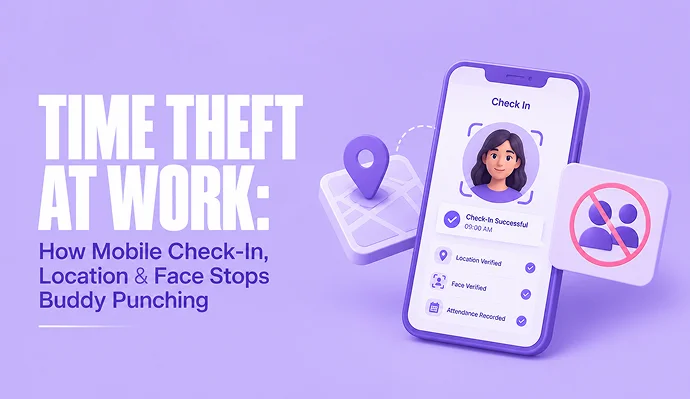
Mobile check-in moves the punch from a shared device to the employee’s own phone. With the Resourceinn mobile app, employees mark attendance from their phones, including staff who work outside the main office. That one change helps you prevent buddy punching, because a punch now belongs to a person and a phone instead of a shared register. It cuts time theft at work at the source.
Two checks make it stronger. One verifies where the punch happens. The other verifies who is punching.
A Location Check at the Moment of the Punch
A location check compares the phone’s position with the place the employee is meant to be, such as a branch or a site. If the punch comes from somewhere else, the system can flag it for review. This stops the common case where a colleague punches in for someone who is still at home. The check happens once, at the moment of the punch. It does not follow the employee around.
Face Verification Instead of a Facial Recognition Time Clock
A facial recognition time clock is a fixed device on the wall. It works, but it covers one door, and every branch needs its own. Face verification on a phone goes where the employee goes. The employee takes a quick photo at check-in, and the system can compare it with the face on file. If it does not match, the punch can be flagged. A colleague can lend a phone, but not a face. You can read how face recognition works in the Resourceinn app in our guide.
What Mobile Check-In Does Not Do
Mobile check-in verifies the punch. It does not monitor the day. That difference matters, because many managers worry about tracking staff too closely, and many employees worry about the same thing. A good setup checks identity and place when someone clocks in or out, and nothing else.
Face data is sensitive. Before you collect it, tell employees what you collect, why, and how long you keep it. The U.S. Federal Trade Commission’s policy statement on biometric information names failing to assess foreseeable harms before collecting biometric data as a practice it may scrutinize. Local laws may add consent rules, so check them before you roll out face checks.
How to Prove Time Theft
Proving time theft at work starts with records, because one odd punch proves very little. Patterns prove more. Look for punches that land within a minute of a colleague’s, punches made from outside the work location, and face checks that fail and then pass on a later attempt. Each of these is a signal, not a verdict.
Keep the evidence together: the punch time, the location result, the identity check, and any manager note. Then talk to the employee before you decide anything. Many cases turn out to be a mistake or a misunderstanding, and a fair process protects both sides. A system that logs every attempt makes this far easier than a stack of paper registers.
How to Write a Time Theft Policy That Holds Up
A time theft policy should be short enough that people read it. Cover five things:
- Define it in plain words, with proxy punches and falsified timesheets as named examples.
- State how attendance is recorded, including the face and location checks if you use them.
- List the consequences, from a warning to dismissal, and apply them the same way to everyone.
- Say how concerns are raised and reviewed.
- Ask every employee to read and acknowledge it
Then have the conversation, not only the document. Explain that the checks protect honest employees too, because they stop colleagues from being paid for time they did not work. Check local employment law before you set penalties.
Time theft at work is easier to stop than to investigate. Verify the punch when it happens, keep the record, and make sure everyone has read the policy.
Frequently Asked Questions
What does buddy punching mean?
Buddy punching means one employee clocks in or out for another employee who is late, absent, or elsewhere. The absent employee is paid for time they did not work. It is the most common form of time theft at work in shift-based teams.
Is buddy punching illegal?
Rules differ by country and state, so there is no single answer. Buddy punching is a form of time fraud, and most employers treat it as a serious policy breach that can lead to discipline or dismissal. Whether it is also a criminal offense depends on local law, so confirm with a qualified lawyer before taking action.
Can an employee be fired for time theft?
In most workplaces, yes, if the employer has a written policy and can show the evidence. Time theft is usually listed as a conduct violation. Apply the policy the same way to every employee, keep clear records, and check local employment law before dismissing anyone.
How hard is it to prove time theft?
It is hard without records. A single odd punch proves little. Patterns are easier to prove: repeated punches at the same minute as a colleague, punches from a location away from the site, or a face check that fails. A system that logs the time, location, and identity check for each punch gives you that evidence.
How does mobile check-in stop buddy punching?
Mobile check-in ties each punch to the employee’s own phone. It can add a face check to confirm who is punching and a location check to confirm where the punch happens. A colleague cannot clock in for someone else from a different place, and every attempt is logged for review.