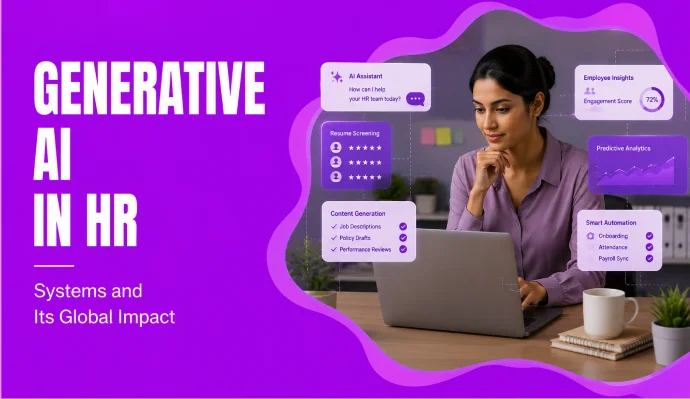

Human Resources (HR) faces a substantial shift because of Generative AI advances, which happen at a rapid pace. Modern HR departments use technology innovations to transform their activities which extend from staff hiring and employee introduction to professional growth support as well as performance assessment systems.
This exploration investigates Generative AI’s rising importance for Human Resources operations and its wide-ranging global consequences. Continue reading to discover more about AI and its impact on Human Resources.
Why Generative AI in HR?
The integration of AI and human resources offers numerous compelling advantages:
- Enhanced Efficiency: Automated tasks in resume screening, along with interview scheduling and employee report generation, allow HR professionals to concentrate on critical strategic activities and deepen employee relationships.
- Improved Decision-Making: HR organizations using AI systems for solution development gain insights from data about employee sentiments, talent resources, and work performance statistics to make objective decisions systematically.
- Enhanced Candidate Experience: Human resources AI implements personalized recruitment processes that shorten candidate vetting timelines and give candidates a more engaging experience.
- Increased Equity and Fairness: By incorporating artificial intelligence tools into human resources, workplaces achieve better bias reduction for the overall hiring and advancement decision procedures that create more equitable work environments.
- Improved Employee Engagement: The use of AI technology by HR professionals helps organizations understand what employees need so they can boost employee engagement alongside better retention rates.
The Rise of Gen AI for HR
The rise of Generative AI has generated a new era of possibilities for HR. By automating repetitive and tiring tasks through data-driven insights, Gen AI is transforming how HR functions operate. This enables organizations to engage in human potential development and unlock their full capabilities. Here are some notable trends generative AI is establishing for the future!
1. Al-Powered Recruitment Process
Some Gen-AI models, such as Casey AI, can assist in creating relevant job postings with relevant job descriptions. You can also create customizable interview questions for specific roles and candidate profiles for very specific job positions, streamlining the recruitment and candidate evaluation process.
The HRMS integration of Gen AI into human resource management systems has expanded the functionality of the HRMS has now expanded. HR professionals can now find the right candidate through prompts given to the AI assistant on their HR software. The integration of artificial intelligence into the field of HR has been truly a game-changer for HR professionals, admins, talent acquisitions, and people in similar roles.
Example:
The scheduling of a Software Engineer position requires a hiring manager to employ ChatGPT for crafting job descriptions and interview questions during the interview process. The combination of Gen-AI integration into the HR system allows for resume analysis. It automatically suggests prime candidate choices. Sharing job description development through automated system generation makes the recruiting process faster.
2. Talent Acquisition with the Help of Gen AI
One major advantage Gen AI has presented for HR and talent acquisition professionals is the ability to draft various email drafts during the recruitment process. They can draft offer letters, appointment letters, responses to candidates, and similar content without creating each one manually, which is time-consuming.
Example:
Through Gen AI, an HR professional creates individualized offer letters and candidate responses that require minimal human effort. The automated system decreases human labor while speeding up and enhancing hiring operations.
3. Automating Payroll and Reducing Human-Error
One of Gen AI’s major advantages for automating payroll and reducing human error is its precision in processing salaries, deductions, and tax calculations. AI-driven payroll systems ensure compliance, minimize errors, and generate accurate reports. This automation reduces manual workload, prevents costly errors, and enhances payroll efficiency without requiring constant human intervention.
4. Making Onboarding a Smooth Process
One of the major advantages that Gen AI has presented for making onboarding a smooth process is its ability to automate document verification, training schedules, and employee introductions. AI-powered assistants provide new hires with queries, while digital workflows streamline paperwork. This ensures a flawless onboarding experience, reduces administrative burden, and helps employees integrate quickly without unnecessary delays.
5. Creating Training and Development (T&D) Sessions
The combination of generative AI in HR can have a substantial impact on employee growth and development. With the help of Gen AI, HR professionals can design “learning and development” experiences for employees for skill gap analysis, performance data, and career progression aspirations.
AI-based training or mentoring has also gained popularity among industry experts. Artificial intelligence can provide employees with one-on-one coaching and real-time feedback, respond to queries, and offer data-driven insights. As a human resources AI tool, this has the extra advantage of reducing the hassle of hiring multiple trainers or scheduling numerous training sessions.
Example:
Gen AI in HR creates specific learning curricula, skill gap analyses, and individual career path monitoring. AI coaching platforms use real-time analytics to give employees instant feedback, eliminating the need for multiple coaches to improve employee growth.
6. Enhancing Employee Engagement and Retention
Gen AI demonstrates its most significant value for employee engagement and retention by interpreting employee sentiments using survey data and feedback. Through artificial intelligence, HR professionals acquire important data, which they use to develop specific employee engagement initiatives for enhanced workplace well-being. This proactive method creates positive workplace conditions while controlling staff turnover and enhancing employee dedication and commitment through automated instead of manual operations.
7. Assisting in Performance Management Tasks
The primary contribution of Gen AI to performance management begins with its tracking capability, which analyzes employee progress aligned with Key Performance Indicators (KPI) using real-time data streams.
Modern performance management products powered by AI technology assemble personalized performance assessments with customized developmental frameworks for employee skill growth initiatives. Real-time automated evaluations guide HR professionals to discover top candidates and facilitate ongoing employee development by eliminating lengthy traditional assessment methods.
8. Automation of HR Operations
Generation AI’s main benefit for HR automation extends to its effective handling of serial administrative duties. Artificial intelligence technology automates payroll functions and attendance management, reducing administrative workloads. The system allows HR professionals to concentrate on strategic tasks while running smooth operations automatically without unreasonable manual input.
9. Playing a Key role in Predictive Analysis
AI for HR professionals has been a helping hand in assisting the analysis of large datasets to uncover patterns. HR AI tools provide analytics through visually appealing data insights and visuals to communicate information in an easy-to-understand and engaging method.
AI for HR professionals offers the advantage of identifying anomalies in data. Generative AI can scan, understand, and then point out unusual patterns in any type of data, such as salary (net or gross salary), performance, employee engagement, or attendance data. You can also create advanced prompts to tackle complex data.
Should HR use AI tools for Efficient Work?
One of the major advantages that AI tools have presented for HR is their ability to enhance efficiency through automation:
- Using Chatbots and Conversational AI – Automates employee queries, onboarding assistance, and HR support.
- Deploying Human Resource Management System (HRMS) – Streamlines workflow automation and improves operational efficiency.
- Human Resource Information System (HRIS) for Data Management: This system ensures the secure storage, retrieval, and management of HR data.
Future Prospects: Will AI replace HR?
Integrating AI in HR creates many opportunities, but it’s crucial to address challenges and ethical considerations. Employers and employees have concerns regarding data privacy, job displacement, and the potential for bias in AI algorithms, which should be carefully explained.
Despite these challenges, the possibility that “AI will replace HR” is far-fetched for now. Instead, the HR professionals who have been working in the background will have more chances of employee engagement. By utilizing AI technology ethically, HR can take time to work on employee-centric activities more. Ultimately, this results in organizational success through employee retention.
Key Findings
The transformation of the HR industry through generative AI is not just a futuristic concept but a reality. Organizations can improve operations, enhance decision-making, and ensure a more engaged workforce with the power of generative AI for HR.
While integrating AI and human resources will undoubtedly have its challenges, the potential rewards are immense. Whether AI takes over the human resources role or not, HR professionals should become well-versed in the potential and capabilities of Gen AI and any other type of artificial intelligence. This approach will greatly help HR in the future.
Frequently Asked Questions!
How will generative AI impact HR?
Generative AI assists in automating human resources tasks. For example, creating content for job posts, responding to queries throughout the onboarding process, providing actionable insights, and more.
What is the impact of AI on HR?
AI in HR has a huge impact on the human resources processes. For example, assisting in forecasting, automating recruiting, error-free payroll processing, and easy employee management are some of the areas.
What is the primary advantage of using generative AI in HR processes?
Best AI tools for HR, integrated with Gen AI, enhance talent management, people management, employee engagement, and more.
How will generative AI change the world?
According to a study, Gen AI can add up to $20 trillion to global GDP by 2030 and save 300 billion work hours a year.
How does generative AI affect the workforce?
Generative AI has impacted almost every industry, with 30% of workers observing their 50% of tasks are affected by either automation or generative AI features. Also, 85% of the workforce reported their 10% tasks being impacted by artificial intelligence.