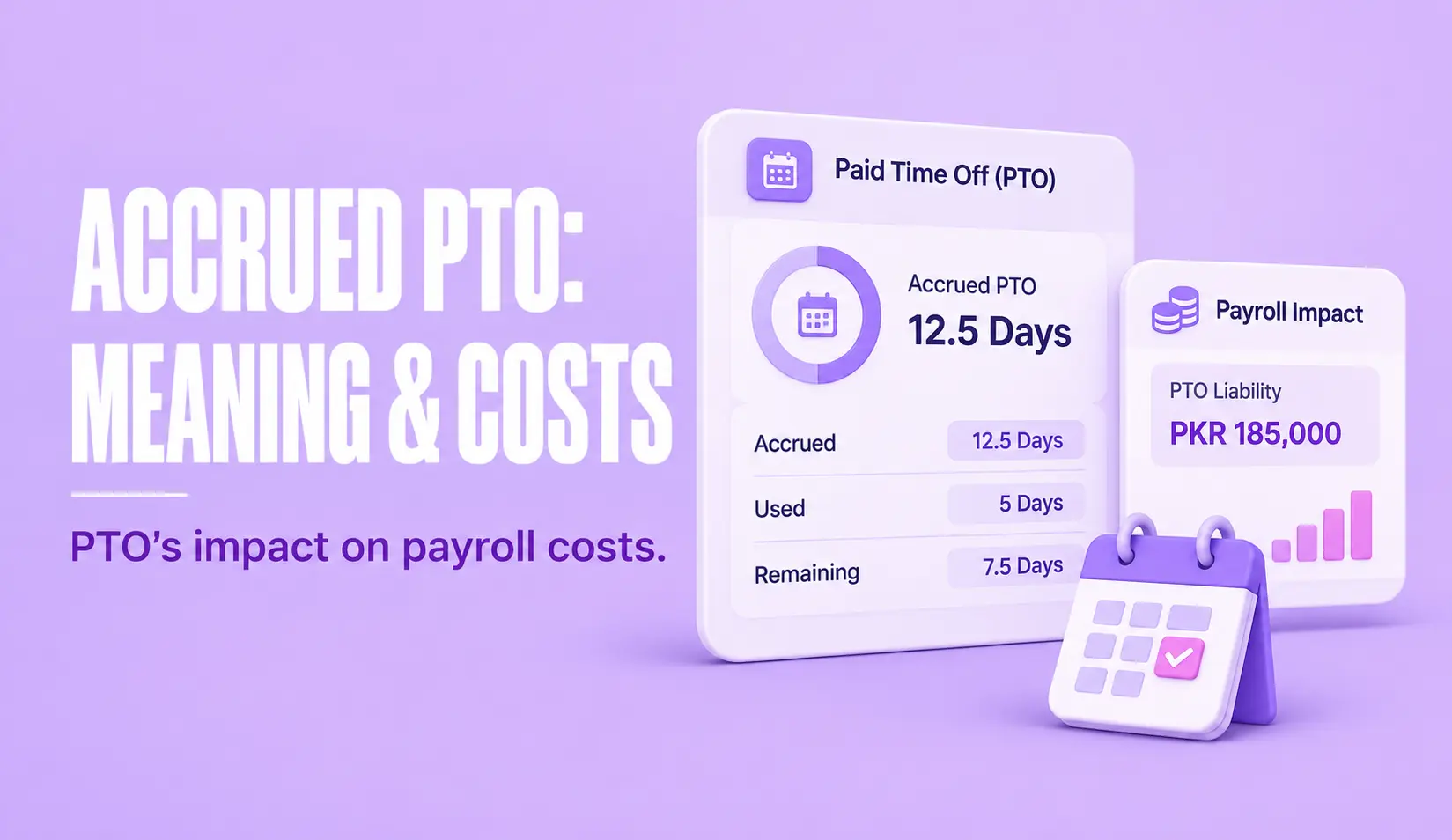

Your employees earn paid time off every pay period. Your finance team often sees none of it until someone asks what happens if everyone cashes in at once. That gap is where accrued paid time off causes trouble, because the balance lives in your HR records while the cost belongs on your books.
This guide explains how accrued paid time off works, how to calculate it, and what it means for your balance sheet and your payout obligations.
What Is Accrued Paid Time Off?
Accrued paid time off is time off that an employee earns gradually, based on hours worked or pay periods completed, instead of receiving a full annual allowance on day one. The balance you see today is what the employee has earned so far, not what they will earn by December.
Accrued PTO sits between two other numbers. The annual entitlement is the most an employee can earn in a year. The available balance is what they can book right now, which can differ if your policy lets people borrow against future time or if requests are still pending. Good leave management keeps all three numbers visible and separate.
The term paid time off accrual also describes the process itself: the rule that adds hours to a balance on a schedule. Accrued vacation is the same idea when your policy tracks vacation apart from sick days.
How Accrued PTO Works: Two Common Accrual Methods
Most policies handle paid time off accrual with one of two methods. Pick one and apply it the same way to every employee in the same group.
Accrual per pay period
The employee earns a fixed number of hours each pay period, whether pay runs weekly, biweekly, semimonthly or monthly. This method is simple to run and easy to explain. Accrued paid time off grows by the same amount each period, even if the employee works a little more or less.
Accrual per hour worked
The employee earns a fraction of an hour for every hour on the clock. This method follows actual time worked, so it suits part time and hourly staff whose hours vary from week to week. It depends on accurate attendance tracking, because a missed clock in becomes a missing fraction of leave. The PTO accrual rate here is that fraction, so accrued paid time off rises with every hour logged.
How to Calculate PTO Accrual (With a Worked Example)
The formulas
Two formulas give you a PTO accrual rate for most policies. A PTO accrual calculator runs the same math behind the screen.
- Per pay period: annual PTO hours ÷ number of pay periods
- Per hour worked: annual PTO hours ÷ annual work hours (2,080 for a 40 hour week over 52 weeks)
Example: 120 hours a year
Say your policy gives 15 days, or 120 hours, of PTO a year. This is an illustration, not a benchmark.
- Biweekly pay (26 pay periods): 120 ÷ 26 = 4.62 hours per pay period.
- Per hour worked: 120 ÷ 2,080 = 0.0577 hours for each hour worked, or about 2.31 hours for a 40 hour week.
Both methods give the employee about the same accrued paid time off over a full year. They differ in timing. Per pay period accrual credits hours on every pay date. Per hour accrual follows the timesheet, so unpaid gaps and short weeks change the balance. Whichever you choose, state the PTO accrual rate in your policy and set a rounding rule, such as two decimal places, so balances do not drift.
What Accrued PTO Costs Your Books
Accrued paid time off that an employee has earned but not taken is a cost you already owe, even if no cash has moved. Accountants call it a compensated absence.
When accrued PTO becomes a liability
Under US GAAP (ASC 710), accrued paid time off becomes a liability when four things are true: the employee’s work has already been done, the right to the time off vests or accumulates, payment is probable, and the amount can be reasonably estimated. The Journal of Accountancy has a summary of the ASC 710 conditions that walks through each one.
A strict use it or lose it policy is the main exception, because unused days never build up, so there is nothing to carry on the books. Most policies that allow carryover do create a liability. Accrued vacation that gets paid out when someone leaves counts too.
How to size the liability
This is the core of accrued PTO accounting: hours, rate, total. For each employee, multiply accrued hours by their current hourly pay rate. An employee with 60 accrued hours at 25 dollars an hour represents 1,500 dollars of liability. That figure is an illustration. Add up every employee’s number and you have the total your accountant needs at period end.
Pay rises increase the total, so refresh it whenever rates change. Pull hours and rates from your payroll software so the figure matches what you would pay. Treat this as general information and confirm the treatment with your accountant.
Caps, Carryover and Payout: Where Policy Meets the Law
Three policy choices control how large accrued paid time off balances, and the liability, can grow:
- Accrual cap: a ceiling on banked hours. Once an employee reaches it, accrual pauses until they take time off.
- Carryover: whether unused hours move into the next year, and how many.
- Payout: whether unused hours are paid when employment ends.
The law sets the outer limits. The U.S. Department of Labor’s FLSA guidance on holidays, vacations and sick leave states that the federal law does not require employers to give time off for them, with or without pay. Most rules come from state law and your own policy.
State rules differ sharply. California treats earned vacation as wages. The California Labor Commissioner’s vacation FAQ says vacation pay accrues as it is earned and cannot be forfeited, even on termination. Caps are a separate question, so confirm what your state allows. Check the rules for every state where you have staff before you write or change a policy.
Tracking Accrued PTO Without Spreadsheet Errors
Spreadsheets work until the first policy change. Then someone edits a formula, a new hire joins mid cycle, or a manager approves leave that never reaches the sheet. Four habits keep accrued PTO accurate:
- Write the accrual rule down once: method, rate, rounding, cap and start date.
- Calculate balances from the same attendance and payroll records, not from retyped copies.
- Keep a dated history of every balance change, so you have an audit trail when someone questions a number.
- Run a balance report before each period close and compare it to the liability figure your accountant uses.
If you do this by hand for more than a handful of employees, a system that links leave, attendance and payroll removes most of the rework. All-in-one HR software keeps those records in one place.
The Bottom Line
Accrued paid time off is an HR balance and a financial obligation at once. Choose a paid time off accrual method, calculate it the same way every period, and size the liability from real hours and current pay rates. Then set caps, carryover and payout rules that fit your state, so the number on your books holds no surprises.
Frequently Asked Questions
How does accrued PTO work?
Accrued PTO is time off an employee earns gradually instead of receiving it all at once. The employer sets a rate, such as a fixed number of hours each pay period or a fraction of an hour for every hour worked. The balance grows as the employee works and shrinks as they take leave, until it reaches any cap in the policy.
How much PTO is accrued per pay period?
Divide the annual PTO hours by the number of pay periods. An employee with 120 PTO hours a year on a biweekly schedule of 26 pay periods accrues about 4.62 hours per pay period.
How much PTO do you accrue for 40 hours worked?
At 120 PTO hours a year, the accrual rate is about 0.0577 hours for each hour worked, based on a 2,080 hour work year. That gives roughly 2.31 hours of PTO for a 40 hour week. Your own figure depends on your policy.
Is accrued PTO a liability on the balance sheet?
Usually, yes. Under US GAAP (ASC 710), an employer records a liability for earned time off when the work has already been done, the right vests or accumulates, payment is probable, and the amount can be reasonably estimated. A strict use it or lose it policy is the main exception, because unused days never accumulate. Confirm the treatment with your accountant.
Does accrued PTO get paid out when an employee leaves?
It depends on state law and company policy. The federal Fair Labor Standards Act does not require payment for vacation time not worked. Some states, such as California, treat accrued vacation as earned wages that cannot be forfeited, so unused hours are generally paid out when employment ends. Check the rules where the employee works.