
HR policies are central to each organization and are the foundation for defining an effective organizational structure. They create a structure that promotes consistency, fairness, and efficiency in managing employees. Due to the constantly changing business conditions, clear HR policies are more important today than ever before.
Because, these policies not only help in attracting and retaining top talent but also ensure compliance with legal standards and make the culture of the organization positive. Let’s discuss the five most important HR policies that every organization should have in place to build a strong and resilient workforce.
1. Hiring and Recruiting Policies
Employees are the basic foundation of your organization, and ensuring a stable foundation requires stable HR policy making. Every HR department should have a clear human resource plan. This plan tells them how to announce positions, create applications, pre-qualify candidates, and move candidates along in the hiring process.
Crafting smooth, engaging, professional hiring policies can help your company seal the deal with top talent. According to statistics by Glassdoor, organizations that invested in a strong candidate experience improved their quality of hires by 70%.
For instance, integrating AI and data analytics into the recruitment process has become crucial in 2024. Because AI tools can enhance candidate matching and streamline the application process, while data analytics help refine job descriptions and target the right candidates. With the “war for talent” aggressively flaring up, you cannot afford to lose top recruits.
Additionally, developing clear policies for remote and hybrid work arrangements has also become essential as these work models are increasingly adopted.
2. Employee Data Security Policies
HR departments with their effective HR policies are held responsible for an incredible amount of sensitive employee data. Data may include onboarding documents and benefits paperwork along with performance evaluations.
One way to verify your employees’ data is safe and secure is to use an employee MIS database. Also, by eradicating paper and storing employee documents on the cloud HR software helps to control who is accessing files and when. It produces an audit trail of all actions on each document.
Moreover, over this period, as the world evolves towards a digital environment, cyber threats are rapidly increasing. Thus, to do this, it is necessary to exclude the critical threat and use modern technologies such as multi-factor authentication and end-to-end encryption.
Furthermore, staying compliant with recent data privacy regulations like GDPR (for Europe) and CCPA (for California) is also crucial.
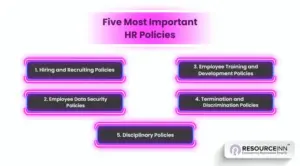
3. Employee Training and Development Policies
According to a recently carried out study by Google, 80% of employees said they would remain with their recruiter longer if they saw a career path within their organization.
As per another report published in The New York Times, “lack of development was the number one reason that forced employees to quit from their respective jobs.” And, turnover is expensive for sure, though; as it could cost as much as 20 percent of the annual salary to replace a midrange position.
Therefore, by the above statistics, the importance of continuing to learn now is proven, and speaks about the opportunities that should be offered to employees, such as online courses and personalized development and trainings programs . Because, nurturing your employees with clear paths for advancement not just help the employee personal growth but also the company in productivity
However, companies also develop mentorship programs to provide guidance and support for career growth. It will prevent top-level talent from moving on while improving your company’s bottom line.
4. Termination and Discrimination Policies
It is the sole responsibility of designing HR policies and procedures to protect workers from any kind of discrimination in the workplace. But all companies do not take this HR policy-making responsibility seriously.
Please do not take it lightly that your company already has adequate measures in place. It’s critical that every HR department prepares, communicates, and consistently enforces effective HR policies that protect employees from facing unfair treatment. Incorporate recent legal updates and best practices for creating an inclusive workplace. It is primarily because of factors on the basis of religion, race, age, health status, gender, and sexual orientation.
5. Disciplinary Policies
When a worker is underperforming it can cause tension for the management in a sense of meeting targets. Managers often lack the necessary managerial competencies to tackle these kinds of situations. Due to this morale suffers when it floats that an employee was arbitrarily punished or terminated. Instituting a clear disciplinary and termination human resource plan can help ensure fair treatment of your employees.
Develop performance improvement plans with specific, measurable goals and provide support and resources to help employees meet these goals. Try to instill confidence in managers and keep your company out of court.
In addition to developing effective HR policies for disciplinary action and termination proceedings, implement modern conflict resolution techniques and alternative dispute resolution (ADR) to address workplace issues. To minimize your efforts on monitoring employees activities, put your focus on HR policy making because it’s important.
In summary, having crafted HR policies is crucial for establishing a strong, compliant and successful organization. By prioritizing key areas like recruitment, data security, employee training, handling terminations and discrimination , and disciplinary actions, companies can create a positive and productive work environment in 2024.